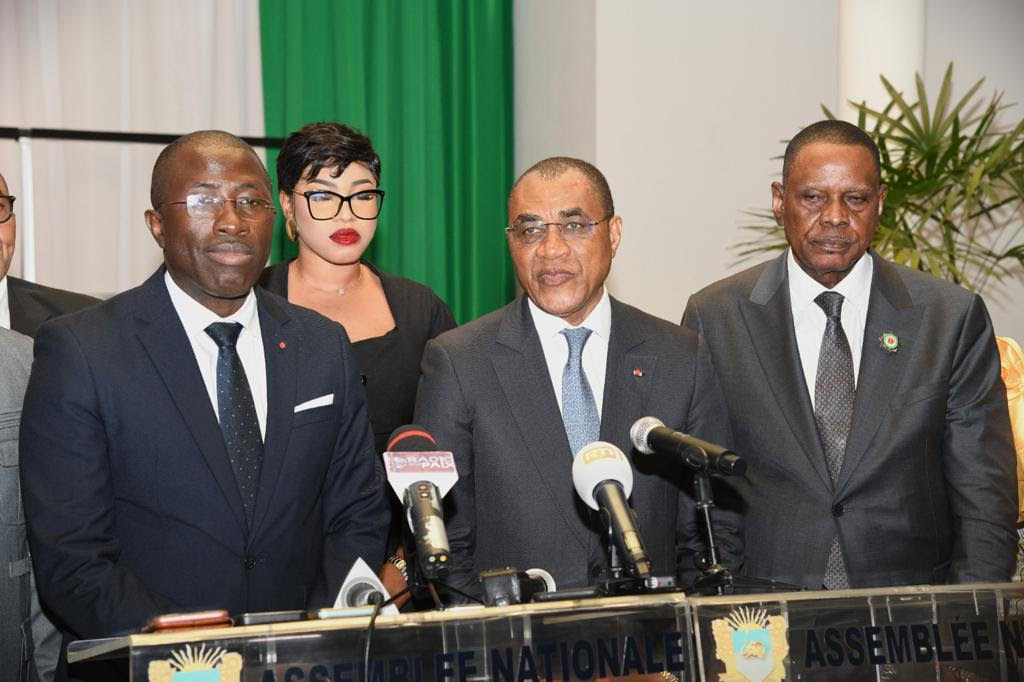
As part of the opening of debates at the National Assembly on the 2024 Finance Bill, the Minister of Finance and Budget, Mr. Adama Coulibaly, presented Côte d’Ivoire’s draft 2024 budget in his introductory remarks on Tuesday, November 7. His presentation to the members of the Economic and Financial Affairs Committee (CAEF) of the lower house of Parliament highlighted the key features of this budget.
Minister Adama Coulibaly first recalled that the budget is balanced in revenues and expenditures at CFAF 13,720 billion. “It represents an increase of 17.3% compared with the budget adopted in 2023. The resources of the 2024 draft budget comprise CFAF 6,569 billion in budget revenues, CFAF 5,851 billion in treasury resources, and CFAF 1,300 billion in revenues from Treasury Special Accounts. Total budget expenditure amounts to CFAF 8,944.7 billion, treasury charges stand at CFAF 3,475.4 billion, and expenditure from Treasury Special Accounts corresponds to the resources, namely CFAF 1,300 billion. The budget is characterized by a tax-to-GDP ratio of 14.4% and a budget deficit of 4%,” he then specified.
A budget structured around programs and appropriations
Continuing his presentation, the Minister of Economy, Finance and Budget indicated that the 2024 budget is structured around 32 appropriations and 134 programs. These programs are implemented by the ministries. In addition to several major projects included in the National Development Plan (PND), such as the construction and equipment of three girls’ excellence high schools (CFAF 5.4 billion), the Abidjan urban train (CFAF 120 billion), the Ferkessédougou dry port (CFAF 53 billion), the hospital program (CFAF 46 billion), sanitation works in the municipality of Yopougon for the first phase (CFAF 29 billion), the wholesale markets of Bouaké and Yopougon (CFAF 7 billion), the operation to secure persons and property (CFAF 8.5 billion), and the Abobo court (CFAF 3 billion), he emphasized two important programs: the second generation of the PSGouv and the PJGouv.
“For the PSGouv, the total cost is estimated at CFAF 3,812 billion. The amount included in the 2024 budget is CFAF 468 billion, with CFAF 348 billion from domestic financing and CFAF 119 billion from external financing. The PJGouv for the 2023–2025 period has an estimated total cost of CFAF 1,118 billion. The amount included in the 2024 budget is CFAF 235 billion, including CFAF 113 billion from domestic financing and CFAF 121 billion from external financing,” he explained.
A budget allocated across nine sovereign missions
The Government’s representative also indicated that the 2024 budget has been allocated across nine (9) sovereign missions. These missions are as follows: Infrastructure Development and Collective Facilities (42.5%); Health and Social Action (13.2%); Environment and Living Environment (12%); Production and Industrial and Commercial Development (8.7%); Defense, Security and Justice (7.3%); Education, Training and Research (6%); General Administration and Economic Development (5%); Culture, Youth, Sports and Leisure (2.5%); Public Authorities, Sovereignty and Governance (2.8%).
Constraints
Minister Adama Coulibaly also noted that, like any budget, the preparation of the 2024 budget faces constraints related to the budget deficit, which decreases from 5.2% to 4% between 2023 and 2024, representing a significant reduction of 1.2 percentage points. He also mentioned mandatory expenditures related to debt service, personnel costs, and subscription-related expenses, while also referring to other types of expenditure concerning investments, transfers, and acquisitions of goods and services. “Other constraints exist, particularly the need to comply with the wage bill-to-tax revenue ratio, which is a community-level commitment. In 2023, we stand at 33.8%, and the objective for 2024 is to reach 31%. We have an increase in tax revenues of CFAF 884 billion between 2023 and 2024. The other constraints lie in the need to increase tax revenue by 0.5 percentage points between 2023 and 2024 and to increase the budget by CFAF 2,026 billion in order to meet the commitments and needs expressed for the development of our country,” added the Minister of Economy, Finance and Budget, before referring to constraints related to the distribution of CFAF 13,720 billion in terms of revenues.
He further emphasized that, with regard to the evaluation of the achievement of program-related objectives since the transition to program-based budgeting in 2020, a positive trend has been observed. “In 2020, the achievement rate was 73%; in 2021, it rose to 82%; and in 2022, it reached 85%. There has therefore been a gradual increase in the achievement rate. We hope that in 2023, we will have a rate above 85%,” concluded the Government’s representative.
Source:
SERCOM MFB